What Is Asphalt?
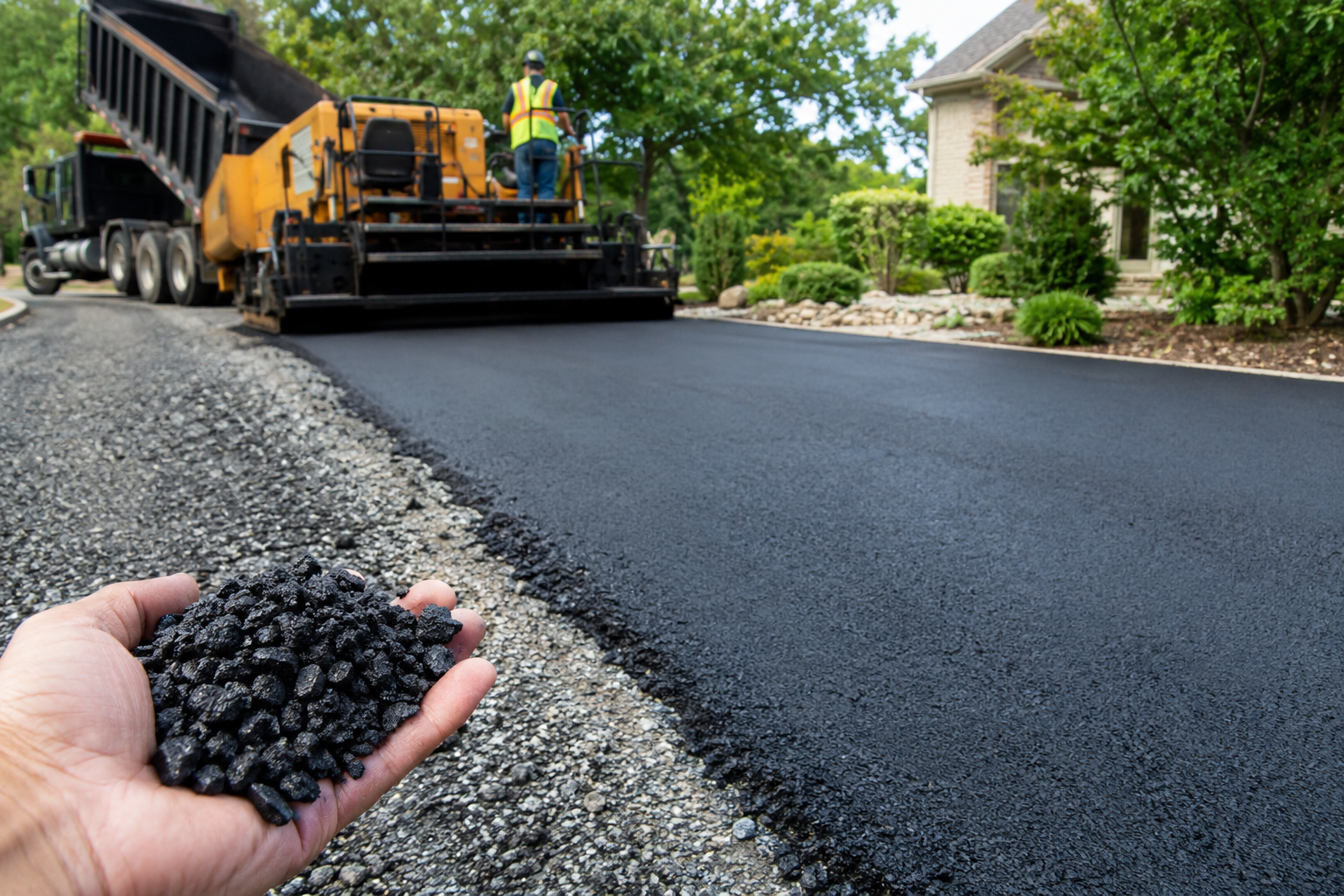
Asphalt pavement is a mixture of mineral aggregate and asphalt binder. The aggregate provides much of the structure and load-bearing capacity, while the asphalt binder holds the particles together and provides flexibility.
Modern asphalt mixtures can contain different sizes and gradations of aggregate. According to the North Carolina Department of Transportation’s asphalt materials manual, aggregate generally makes up the majority of an asphalt mixture by weight, with asphalt binder making up a smaller portion. Air voids are also an important component of the finished mix.
Because asphalt can be engineered for different applications, it is used for residential driveways, commercial parking lots, local streets, major roads, and other paved surfaces. The appropriate mix and pavement structure depend on factors such as expected traffic, site conditions, and project requirements.
What Is Blacktop?
Blacktop is generally an informal term used to describe an asphalt-paved surface. In North America, people commonly use the word when talking about driveways, residential streets, parking areas, and other paved surfaces.
There is not necessarily a completely separate material called blacktop. Pavement professionals and engineers often use “asphalt,” “asphalt concrete,” or related technical terms instead. Pavement engineering references also identify blacktop as a generic term for asphalt concrete.
This is why a homeowner may ask for a blacktop driveway while a paving contractor describes the same project as an asphalt driveway.
Blacktop vs Asphalt: Are They Actually Different?
The biggest point to understand about blacktop vs asphalt is that the difference is often one of terminology rather than a dramatic difference in material.
Both typically rely on aggregate and asphalt binder. However, asphalt pavement can be produced in many different mix designs, with variations in aggregate size, gradation, binder characteristics, additives, and other specifications.
Some sources describe blacktop as a particular type or style of asphalt mix, sometimes associated with residential or lighter-duty applications. Other paving professionals use blacktop simply as a common name for asphalt pavement. Because terminology can vary by region and contractor, it is more useful to ask about the actual mix, pavement thickness, base preparation, and intended application than to rely solely on the word “blacktop.”
Composition and Mix Design
One of the most important aspects of blacktop vs asphalt is understanding that asphalt pavement is not based on one universal recipe.
Aggregate can include different combinations of crushed stone, gravel, sand, and other mineral materials. The aggregate gradation determines how particles of different sizes fit together. The asphalt binder coats the aggregate and helps bind the finished pavement together.
The Asphalt Institute describes aggregate gradation as the distribution of particle sizes in an asphalt mixture. Different gradations can be selected to meet specific pavement requirements.
This means two paved surfaces can look slightly different while both legitimately being asphalt pavement.
A contractor should therefore specify the appropriate material based on the application instead of choosing a surface simply because it is called blacktop or asphalt.
Where Is Asphalt Commonly Used?
Asphalt is extremely versatile. It can be designed for a wide range of pavement applications, including:
- Residential driveways
- Commercial parking lots
- Neighborhood roads
- City streets
- Highways
- Access roads
- Industrial areas
- Recreational surfaces
The pavement structure and mix should be selected according to the loads and conditions expected at the site.
For example, a residential driveway may experience primarily passenger vehicles, while a commercial property could experience delivery trucks, frequent turning movements, and heavier traffic. These situations can require different pavement designs even though both surfaces are commonly described as asphalt.
Where Is Blacktop Commonly Used?
The word blacktop is frequently associated with residential driveways and smaller paved areas. Homeowners may say they want a new blacktop driveway when they are actually requesting an asphalt paving installation.
Blacktop can also be used informally to describe neighborhood streets, parking areas, playground surfaces, and other paved spaces.
The important thing is not necessarily the name used to describe the pavement. Instead, property owners should discuss the project’s actual requirements with their paving contractor.
Ask about the pavement thickness, aggregate mix, base preparation, drainage, compaction, expected traffic, and maintenance requirements.
Appearance Differences
Freshly installed asphalt typically has a dark appearance that gradually changes as the pavement ages. Exposure to sunlight, weather, vehicle traffic, oxidation, and other environmental factors can affect its color and surface appearance.
The aggregate used in the mixture can also influence the texture and visual characteristics of the finished pavement.
A smoother surface does not automatically mean that one material is “asphalt” while a rougher surface is “blacktop.” Surface texture can result from the specific mix design, aggregate gradation, installation practices, and finishing process.
Therefore, visual appearance alone is not a reliable way to determine whether a pavement should technically be called asphalt or blacktop.
Blacktop vs Asphalt for Driveways
If you are considering a new driveway, you may wonder whether blacktop vs asphalt should affect your decision.
For most homeowners, the more important considerations are the quality of the installation and whether the pavement is properly designed for the property.
A well-built asphalt driveway should begin with appropriate preparation of the existing soil and base. Drainage should be considered because standing water and poor drainage can contribute to pavement deterioration. The asphalt layer should also have an appropriate thickness for expected vehicle loads.
Compaction is another critical part of the installation process. Proper compaction helps create a dense pavement structure capable of handling normal traffic.
Consequently, comparing two paving contractors based solely on whether one uses the word “blacktop” and the other uses “asphalt” may not tell you much about the quality of the proposed work.
Blacktop vs Asphalt for Parking Lots
Parking lots have different requirements from residential driveways because they can experience substantially more traffic, turning movements, and heavier vehicles.
A commercial parking lot should be designed around expected traffic and site conditions. The contractor may consider the number and type of vehicles, delivery traffic, drainage, subgrade conditions, pavement thickness, and long-term maintenance requirements.
If a contractor refers to the project as blacktop while another calls it asphalt paving, ask both companies to provide comparable specifications. This allows you to compare the actual proposed pavement rather than simply comparing terminology.
Does One Last Longer Than the Other?
There is no simple lifespan rule stating that every asphalt surface lasts longer than every blacktop surface.
Pavement longevity depends on numerous factors, including:
- Material quality
- Mix design
- Pavement thickness
- Base and subgrade preparation
- Drainage
- Climate
- Traffic volume
- Vehicle loads
- Installation quality
- Preventive maintenance
- Timely repairs
A properly designed and installed pavement can perform well for many years, while a poorly prepared pavement can develop problems much sooner.
Cracking, potholes, rutting, drainage problems, and surface deterioration are often related to the pavement’s design, construction, environment, or maintenance rather than simply whether someone calls the surface blacktop or asphalt.
Maintenance Considerations
Both asphalt and surfaces commonly called blacktop benefit from routine maintenance.
Property owners should watch for cracks, potholes, drainage problems, raveling, and other signs of deterioration. Addressing smaller problems early can help prevent water from penetrating deeper into the pavement structure.
Sealcoating may also be considered where appropriate. It can help protect the surface from oxidation and environmental exposure, although it is not a substitute for correcting structural pavement problems.
Regular inspections are especially useful for commercial properties because parking lot deterioration can affect appearance, drainage, accessibility, and day-to-day operations.
Choosing a Paving Contractor
Whether you call your project blacktop or asphalt, the contractor you select can have a major impact on the finished pavement.
When comparing a naples paving company with other contractors, look beyond the terminology used in the estimate. Ask about the proposed pavement thickness, base preparation, drainage, mix specifications, project timeline, warranty, and maintenance recommendations.
You should also ask whether the contractor has experience with projects similar to yours. A residential driveway, commercial parking lot, and heavily trafficked roadway can have very different requirements.
A professional contractor should be able to explain the proposed paving system in straightforward terms and explain why the selected materials and construction methods are appropriate for your property.
What Should You Ask Before Paving?
Before signing a paving contract, consider asking:
- What type of asphalt mix will be used?
- How thick will the completed pavement be?
- How will the existing base be prepared?
- How will drainage be addressed?
- How will the pavement be compacted?
- Is the quoted price for complete installation or only the surface?
- What maintenance will be recommended after installation?
- What warranty is included?
- How will damaged areas be repaired if problems develop?
- Does the contractor have experience with similar properties?
These questions can provide much more useful information than simply asking whether the contractor installs blacktop or asphalt.
Blacktop vs Asphalt: The Bottom Line
The debate over blacktop vs asphalt can sound more complicated than it really is. In everyday use, blacktop is commonly used as an informal name for asphalt pavement. In professional and engineering contexts, asphalt and asphalt concrete are more precise terms.
There can be genuine differences between asphalt mixtures, but those differences are determined by factors such as aggregate gradation, binder characteristics, pavement design, traffic requirements, climate, and installation specifications.
For homeowners and property managers, the most important decision is therefore not simply choosing between the words “blacktop” and “asphalt.” Instead, focus on the quality of the materials, site preparation, drainage, pavement thickness, compaction, workmanship, and maintenance plan.
Understanding the terms helps you choose wisely. When you understand what is actually being proposed for your property, you can compare estimates more accurately and make a more informed paving decision.
Frequently Asked Questions
Is blacktop the same as asphalt?
In everyday North American usage, blacktop is commonly used as an informal term for asphalt pavement. Some paving professionals may use the terms interchangeably, while others use blacktop to describe a particular asphalt mix or application.
Is blacktop cheaper than asphalt?
Not necessarily. Since blacktop and asphalt can refer to overlapping materials, cost depends more on the project’s specifications, pavement thickness, site preparation, labor, material requirements, accessibility, and overall project size.
Is asphalt stronger than blacktop?
There is no universal answer. Pavement strength depends on the specific mix design, pavement structure, base preparation, thickness, compaction, traffic conditions, and other factors. The terminology alone does not determine pavement performance.
Which is better for a driveway, blacktop or asphalt?
For most homeowners, the distinction is largely terminology. A quality asphalt driveway can be designed specifically for residential traffic. Rather than focusing on the label, compare the proposed mix, thickness, base preparation, drainage, installation process, and contractor experience.
Can blacktop be used for a commercial parking lot?
Yes. The word blacktop is sometimes used informally for paved parking areas. However, a commercial parking lot should be designed according to its expected traffic, vehicle loads, drainage requirements, and site conditions.
How long does an asphalt or blacktop driveway last?
There is no single lifespan that applies to every driveway. Pavement life depends on installation quality, materials, drainage, climate, traffic, soil conditions, and maintenance. Proper design and timely maintenance can help extend pavement performance.
Should I choose a contractor that says asphalt or blacktop?
The terminology should not be the deciding factor. Ask potential contractors for detailed specifications covering the pavement mix, thickness, base preparation, drainage, compaction, maintenance recommendations, and warranty.
What is the most important factor in asphalt paving?
Proper design and installation are among the most important factors. A quality pavement system requires suitable materials, adequate preparation, appropriate thickness, proper drainage, and effective compaction.