Every commercial property is unique, but they all share one critical vulnerability: the roof over their heads. A failing roof does not just mean a minor leak; it means disrupted daily operations, damaged inventory, compromised specialized equipment, and potential safety hazards for employees and patrons. When facility managers and business owners must embark on a major roofing project, understanding the scope, timelines, and specialized materials involved is crucial.
The commercial sector demands a far higher level of structural engineering and logistical planning than standard residential jobs. From hospitals to warehouses, Commercial Roofing brings scalable solutions for complex commercial roofing needs. Whether you are overseeing a sprawling industrial complex, a retail shopping center, or a multi-story medical facility, knowing exactly what to expect during the assessment, installation, and post-project phases ensures you can keep your business running smoothly while protecting your long-term capital investments.
1. The Initial Diagnostic Assessment
A commercial roofing project never begins with a simple visual glance. Because commercial roofs are often low-slope (flat) and contain multiple layers of insulation, decking, and membrane, a surface-level inspection is entirely insufficient. When you hire a professional commercial roofing contractor, the first step is a comprehensive diagnostic assessment.
- Core Sampling: Contractors will extract a small, cylindrical cross-section of your roof. This reveals the existing layer structure, the thickness of the insulation, and the condition of the underlying structural deck (wood, steel, or concrete). It also determines if a complete tear-off is legally required by local building codes, or if a new system can be overlaid.
- Infrared Moisture Scans: Advanced contractors utilize thermal imaging drones or handheld infrared cameras after dusk to detect trapped moisture beneath the membrane. Water retains heat longer than dry insulation, allowing roofers to map out exact areas of failure without unnecessary destructive testing.
- Drainage Analysis: Flat roofs rely heavily on complex drainage systems. Your contractor will evaluate the placement and flow of scuppers, internal drains, and gutters to ensure standing water (ponding) will not degrade your new investment.
2. Selecting the Right Material for Your Facility
Unlike residential properties that primarily rely on asphalt shingles, commercial properties require specialized, highly durable membranes designed to cover vast square footage and withstand intense UV exposure, chemical exhausts, and heavy foot traffic from HVAC technicians.
| Commercial System | Material Composition | Best Use Case |
|---|---|---|
| TPO (Thermoplastic Polyolefin) | A single-ply white membrane that reflects UV rays and is welded together with hot air for seamless protection. | Large retail centers and warehouses looking for high energy efficiency and a cost-effective, puncture-resistant solution. |
| EPDM (Ethylene Propylene Diene Terpolymer) | A highly durable, synthetic rubber roofing membrane (typically black) known for its incredible elasticity. | Facilities in regions with extreme temperature fluctuations or buildings requiring a long-lasting, weather-resistant barrier. |
| PVC (Polyvinyl Chloride) | A flexible, thermoplastic membrane that is highly resistant to chemical exposure, animal fats, and fire. | Restaurants, chemical manufacturing plants, and agricultural facilities where exhaust vents emit harsh elements. |
| Liquid-Applied Coatings | Silicone or acrylic liquid rolled or sprayed over an existing, structurally sound roof to form a seamless waterproof barrier. | Facilities looking to extend the life of their current roof by 10-15 years without the cost of a full structural tear-off. |
Export to Sheets
3. Navigating Logistics and Business Continuity
One of the most significant concerns for any property manager is how a massive construction project will impact daily business. What sets elite commercial roofers apart is their ability to execute a multi-million dollar installation while your business remains fully operational.
Here is what you should expect regarding logistics:
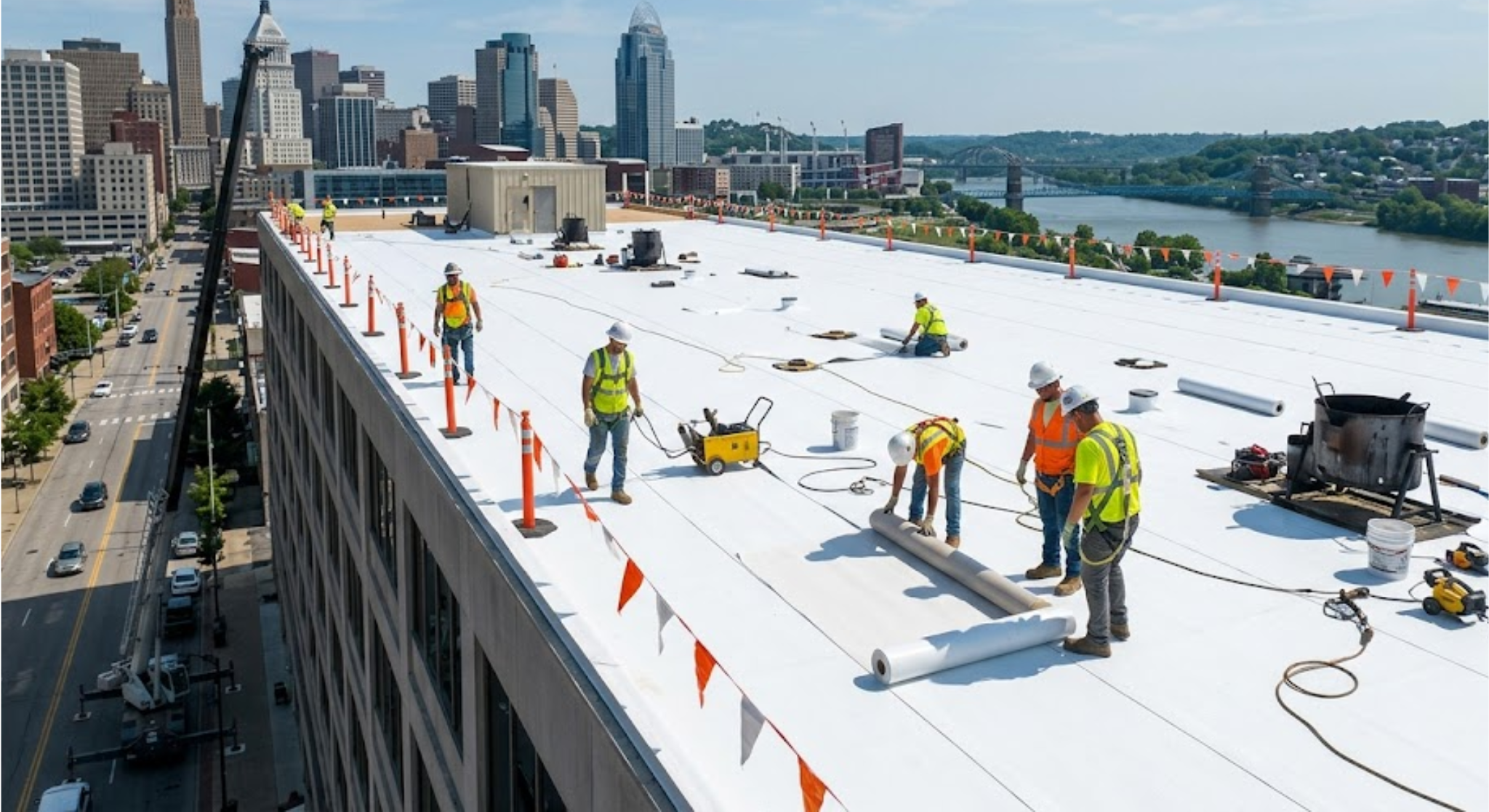
- Staging and Crane Operation: Commercial materials are heavy and require heavy machinery. Your contractor should provide a detailed site plan indicating exactly where materials will be staged, where dumpsters will be placed, and when cranes will be used, ensuring they do not block loading docks or customer entrances.
- Safety Protocols (OSHA Compliance): Expect strict adherence to safety regulations. Professional crews will set up highly visible perimeter warning lines, safety monitors, and tie-off harnesses. This protects not only the roofing crew but also your employees and patrons on the ground.
- Odor and Noise Management: Installing systems like built-up roofing (BUR) or using specific adhesives can produce strong odors. A professional team will coordinate with your facility management to temporarily adjust HVAC air intakes so fumes and construction noise do not disrupt your indoor environment.
4. Post-Installation: Warranties and Preventative Maintenance
A commercial roof is not a “set it and forget it” asset. The handover process is just as critical as the installation.
Once the project is complete, you should receive a comprehensive No Dollar Limit (NDL) warranty from the manufacturer. This elite tier of warranty covers both defective materials and faulty workmanship, meaning the manufacturer will pay to fix the roof regardless of the cost, provided it was installed by one of their certified contractors.
However, these warranties require upkeep. Expect your roofing partner to transition you into a preventative maintenance program. By scheduling bi-annual inspections (usually in the spring and fall), contractors can clear drains of debris, seal minor punctures, and ensure that a $500 maintenance fix never turns into a $50,000 premature replacement.
Conclusion
Replacing or repairing a commercial roof is a major logistical undertaking, but it does not have to be a disruptive nightmare for your operations. By understanding the rigorous diagnostic phase, selecting the optimal material for your specific industry, and partnering with a contractor who prioritizes job site logistics, you can navigate the process with confidence. Trusting seasoned experts like Apply Rite ensures that your facility is protected by a durable, high-performance system designed to scale with your long-term business goals.
Frequently Asked Questions (FAQ)
Q: Can I just put a new commercial roof over my old one to save money?
A: It depends on local building codes and the condition of your existing roof. Most municipalities allow a maximum of two roofing layers. If your core samples show you only have one layer and the underlying insulation is dry, a “recover” overlay is often possible. If the insulation is saturated or you already have two layers, a full tear-off is legally required.
Q: How long does a commercial flat roof typically last?
A: The lifespan depends heavily on the material and the maintenance routine. A high-quality TPO, PVC, or EPDM single-ply system generally lasts between 20 to 30 years. Regular bi-annual maintenance and the application of restorative coatings can push that lifespan even further.
Q: Will installing a white TPO roof actually lower my energy bills?
A: Yes. White thermoplastic membranes (like TPO and PVC) are highly reflective. By bouncing the sun’s UV rays away from the building rather than absorbing them like dark surfaces do, they significantly reduce the burden on your facility’s HVAC system, which can lead to substantial energy savings during peak summer months.