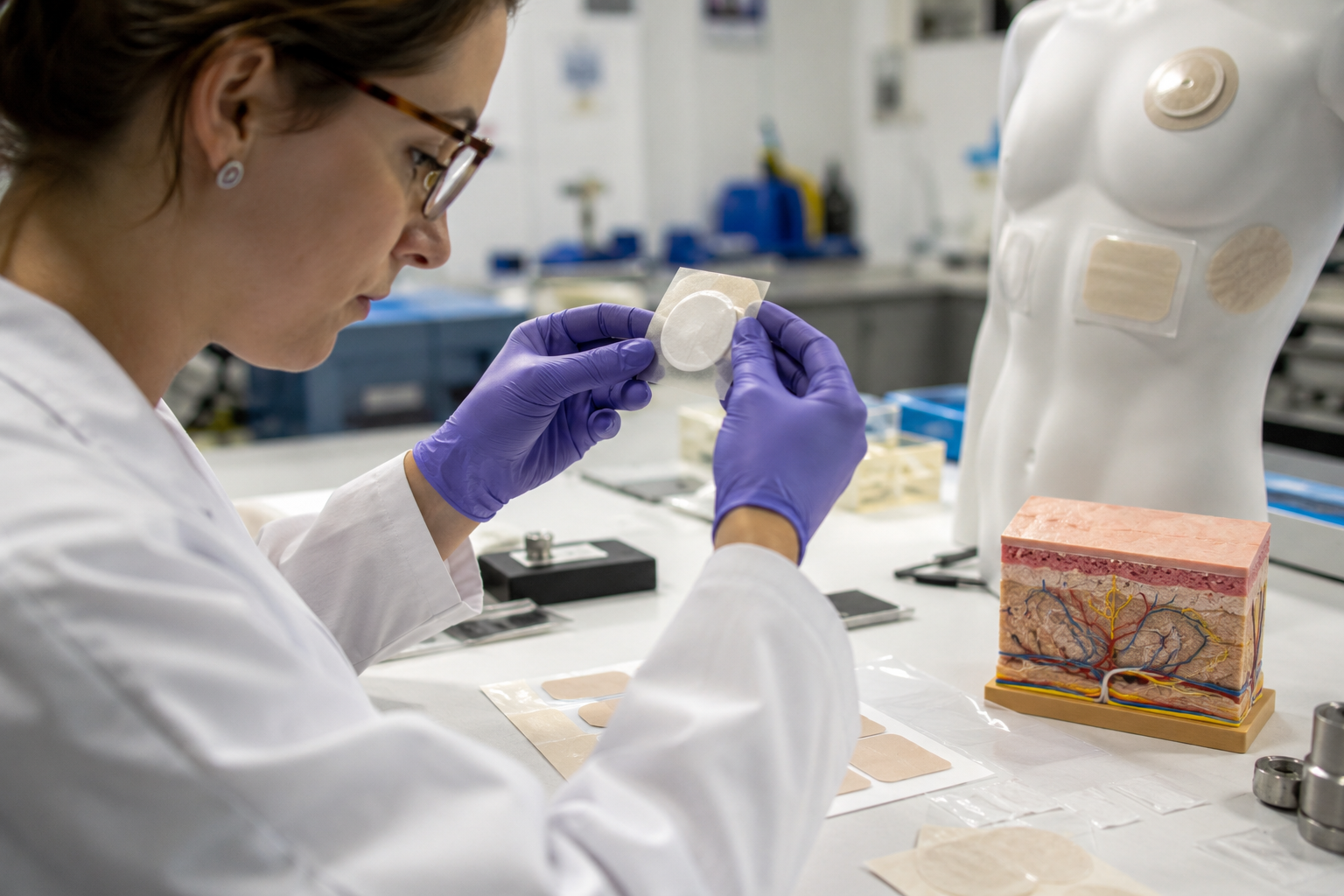
Why Medical Adhesive Selection Matters
An adhesive may represent only one component of a medical device, but its performance can affect the entire product. If an adhesive fails prematurely, the device may move, lose contact, become contaminated, or stop functioning as intended.
For wearable devices, adhesive performance becomes particularly challenging because human skin is constantly moving and changing. Perspiration, body oils, temperature, humidity, and repeated motion can all influence the bond. The location of the device also matters. An adhesive applied to the upper arm may face different conditions than one used on the chest, abdomen, or another highly mobile area.
Adhesion and skin comfort drive wearable performance.
A successful medical adhesive needs to balance secure attachment with appropriate skin interaction. Excessively aggressive adhesion can make removal painful or contribute to skin damage, while insufficient adhesion can cause the device to detach before the intended wear period ends.
Start With the Device Requirements
Before selecting an adhesive chemistry, define what the device needs to accomplish.
Consider questions such as:
- How long will the device remain attached?
- Will it be applied once or repeatedly?
- Does the device need to be repositionable?
- Will the patient shower, exercise, or swim while wearing it?
- How flexible is the device?
- What materials will the adhesive contact?
- How much movement will occur at the application site?
- Is the patient population likely to include people with sensitive or fragile skin?
- Does moisture need to escape from beneath the device?
These questions establish the performance requirements for the adhesive.
For example, a disposable device designed for a short application may prioritize initial tack and reliable attachment. A wearable sensor designed for several days of use may require a different balance of adhesion, flexibility, moisture management, and skin compatibility.
Understand the Main Types of Medical Adhesive
There is no universal adhesive that works for every medical application. Acrylic, silicone, hydrocolloid, synthetic rubber, hydrogel, and specialized hybrid formulations each offer different characteristics.
Acrylic Adhesives
Acrylic adhesives are widely used in medical applications because they can provide strong and durable adhesion. They may be suitable when reliable attachment is a primary requirement, particularly for devices that need to remain securely attached during activity.
Some acrylic formulations develop stronger bonds over time as the adhesive conforms to the microscopic features of the skin.
However, stronger adhesion is not automatically better. If the adhesive is too aggressive for a particular patient or application, removal may become uncomfortable. The appropriate formulation depends on the device, wear time, skin condition, and intended use.
Silicone Adhesives
Silicone-based adhesives are frequently considered when gentle skin interaction is important. Silicone gel adhesives can offer conformability and relatively gentle removal, making them useful for applications involving sensitive skin or repeated application.
Research and industry testing show that performance can vary considerably even within the same adhesive category, so developers should evaluate specific formulations rather than assuming that all silicone or acrylic adhesives will behave identically.
Silicone can also be useful when bonding to silicone components within a device, where conventional acrylic adhesives may have difficulty achieving an effective bond because silicone has a low surface energy.
Hydrocolloid Adhesives
Hydrocolloid systems combine adhesive properties with moisture-absorbing capabilities. They can be useful in applications where moisture management is an important consideration, including certain wound care products.
Hydrocolloid materials may help manage moisture around the skin interface, although the overall construction of the device must still be considered. The adhesive is only one part of the moisture-management system.
Synthetic Rubber Adhesives
Synthetic rubber adhesives can provide strong adhesion and may work particularly well with certain low-surface-energy substrates. They are often considered for bonding internal construction layers rather than serving as the primary skin-contact adhesive.
This distinction is important because a device may require multiple adhesive systems. One adhesive could secure a component within the device while another is optimized for skin contact.
Consider Skin Compatibility
The skin is not a uniform engineering surface. Different patients have different levels of sensitivity, hydration, oil production, and tolerance to adhesive removal.
The application location can also affect performance. Areas exposed to frequent movement or perspiration may require different characteristics than relatively stable, dry areas.
Biocompatibility should be evaluated as part of the device development process. FDA guidance identifies endpoints such as cytotoxicity, sensitization, and irritation for surface devices contacting intact skin, with considerations influenced by contact duration.
Developers should therefore avoid selecting an adhesive solely because it demonstrates strong laboratory adhesion. A material that bonds exceptionally well but causes unacceptable irritation may not be an appropriate solution.
Evaluate Moisture and Perspiration
Sweat is one of the major challenges for wearable medical devices.
Moisture can affect the interface between the skin and adhesive, potentially weakening the bond. Moisture vapor transmission rate, or MVTR, is therefore an important factor when evaluating an adhesive and its backing construction. Industry guidance notes that insufficient moisture escape can contribute to adhesive failure.
The backing material also matters. A high-MVTR adhesive may not solve the problem if the rest of the device prevents moisture from escaping.
Testing should reproduce realistic conditions whenever possible. If the device is intended for active users, evaluations may need to consider movement, perspiration, temperature, and extended wear rather than relying exclusively on short laboratory tests.
Match Adhesion to Wear Time
Wear time should be one of the first requirements established during adhesive selection.
A device worn for several hours has different requirements from one intended to remain attached for multiple days. Long-duration applications may need greater resistance to moisture, movement, and environmental exposure.
At the same time, longer wear does not necessarily mean that the adhesive should simply be made stronger. Skin condition can deteriorate when an overly aggressive adhesive remains attached for extended periods or is removed improperly.
The objective is to achieve controlled adhesion, where the device stays securely positioned throughout its intended use while allowing appropriate removal.
Test the Adhesive With the Actual Device
One of the most important steps in selecting a medical adhesive is testing it as part of the finished device.
An adhesive may perform differently depending on:
- Device substrate
- Backing material
- Adhesive thickness
- Coat weight
- Device flexibility
- Surface texture
- Sterilization method
- Packaging
- Storage conditions
- Skin location
- Application technique
Testing isolated adhesive samples provides useful information, but final-device testing offers a much more realistic picture of performance.
Developers should evaluate properties such as peel adhesion, tack, shear strength, conformability, residue, repositionability, and removal behavior. For wearable devices, testing under simulated movement and perspiration can provide additional insight.
Consider Regulatory and Biocompatibility Requirements
Medical adhesive selection should be incorporated into the broader regulatory strategy for the device.
FDA’s biocompatibility framework considers the materials that come into direct or indirect contact with the body and evaluates biological safety based on the device’s characteristics and contact conditions.
Contact duration is another important consideration. FDA categorizes contact as limited when it is 24 hours or less, prolonged when it is more than 24 hours through 30 days, and long term or permanent when it exceeds 30 days.
The adhesive should therefore be considered part of the overall biological safety evaluation rather than treated as an independent packaging or manufacturing detail.
Work With Experienced Development Partners
Choosing the right adhesive can require expertise in polymer chemistry, materials science, skin interaction, device engineering, and manufacturing.
A specialized development partner can help evaluate candidate formulations, conduct performance testing, identify compatibility issues, and optimize an adhesive for a particular application.
This is where organizations such as R & D Medical Products can be valuable during product development. An experienced research and development partner can help manufacturers move beyond generic adhesive selection and focus on the requirements of the actual medical device.
Customization may be especially useful when standard off-the-shelf products cannot provide the required combination of adhesion, flexibility, moisture management, and skin comfort. Medical adhesive suppliers also develop customized formulations for specific skin types, device materials, and application requirements.
Common Mistakes to Avoid
One common mistake is choosing an adhesive based only on maximum bond strength. Strong adhesion does not necessarily translate into better medical-device performance.
Another mistake is overlooking removal. The adhesive must not only keep the device in place, but also allow removal consistent with the intended use.
Ignoring moisture is another potential problem. A device that performs well in a dry laboratory environment may behave very differently when exposed to sweat and movement.
Finally, developers should avoid assuming that one adhesive chemistry will work for every application. Even within broad categories such as acrylic and silicone, individual formulations can have substantially different performance characteristics.
Build a Balanced Adhesive Selection Strategy
The best medical adhesive is the one that satisfies the complete set of requirements for the device.
A practical selection process should consider:
- Application site: Determine where the device will be worn or applied.
- Wear duration: Establish the expected attachment period.
- Skin profile: Account for sensitive, fragile, oily, dry, or perspiring skin.
- Device substrate: Confirm that the adhesive bonds effectively with the materials used.
- Environmental exposure: Consider water, sweat, temperature, and physical activity.
- Adhesion requirements: Evaluate tack, peel, shear, and long-term bond stability.
- Removal requirements: Determine whether gentle or repeated removal is necessary.
- Biocompatibility: Evaluate the adhesive within the device’s biological safety strategy.
- Manufacturing: Confirm that the adhesive can be coated, laminated, converted, packaged, and sterilized as required.
- Real-world testing: Validate performance using conditions that represent actual use.
By approaching adhesive selection as a complete engineering and patient-experience problem, manufacturers can reduce the likelihood of adhesive failure and improve overall device usability.
Final Thoughts
A medical device can have sophisticated electronics, sensors, materials, and software, but its performance can still be compromised if the adhesive does not work properly. The adhesive must maintain an appropriate bond while accommodating movement, moisture, skin variability, and the practical needs of patients.
Selecting the right medical adhesive requires more than comparing adhesion numbers. It requires understanding the device, the user, the application environment, regulatory considerations, and manufacturing process as a complete system.
For companies developing new wearable, wound care, diagnostic, or skin-contact medical products, early adhesive evaluation can help identify problems before they become expensive redesigns. Working with experienced R&D specialists and testing candidate materials under realistic conditions can provide a stronger foundation for reliable and comfortable medical devices.
Frequently Asked Questions
What is a medical adhesive?
A medical adhesive is an adhesive material formulated or selected for use in medical applications. Depending on the product, it may attach a device to skin, secure components within a medical device, hold wound-care materials in place, or serve another specialized function.
What types of medical adhesive are commonly used?
Common categories include acrylic, silicone, hydrocolloid, synthetic rubber, hydrogel, and specialized hybrid adhesives. Each category offers different combinations of adhesion, flexibility, moisture management, and skin interaction.
Is stronger medical adhesive always better?
No. Excessively strong adhesion can make removal difficult and may contribute to skin trauma. The appropriate adhesive should provide enough attachment strength for the intended application while meeting skin comfort and removal requirements.
How long can a medical adhesive remain on the skin?
The appropriate wear time depends on the specific adhesive, device, formulation, application site, and intended use. Adhesives should be validated for the actual duration and conditions specified for the medical device.
Why is moisture important when selecting an adhesive?
Sweat and moisture can affect adhesive performance and contribute to premature detachment. Moisture vapor transmission and the complete device construction should therefore be considered during development.
Should medical adhesives be tested for biocompatibility?
Yes. The adhesive should be considered within the device’s overall biological safety evaluation when it contacts the body. Applicable evaluation requirements depend on factors including the type and duration of contact.
Can medical adhesives be customized?
Yes. Adhesive formulations and constructions can be developed or modified to address specific requirements such as sensitive skin, extended wear, moisture management, repositionability, or compatibility with particular device materials.